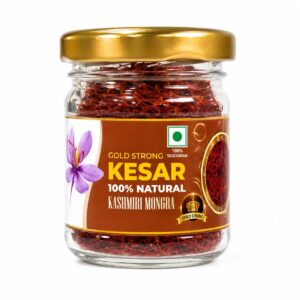
Saffron (kesar) is the world’s most expensive spice – and, sadly, one of the most copied. Dyed corn silk, coloured flower petals and even shredded paper are sold as “kesar”. Here is how to understand what you are buying and check it yourself at home.
Why is saffron so precious?
Each saffron flower (Crocus sativus) has only three thin red threads (stigmas). They are picked by hand, early in the morning, during a short harvest in October and November. It takes roughly one and a half lakh flowers to make just one kilogram of saffron. In India, the most famous saffron fields are in Pampore, near Srinagar in Kashmir.
Mongra vs Lachha saffron – what’s the difference?
- Mongra (also called Mogra) – only the deep red top part of each thread. The yellow lower part is removed by hand. This gives the strongest colour and aroma, and is the highest grade of Kashmiri saffron.
- Lachha – the red thread along with its yellow-white tail, sold in bunches. Good quality, but you pay partly for the yellow part, which adds very little colour or flavour.
So when you compare prices, remember: 1 gram of Mongra contains more of the red part than 1 gram of Lachha.
5 simple checks for real saffron
1. The water test
Drop 2–3 threads into a small glass of cold water and wait. Real saffron releases a golden-yellow colour slowly, over 10–15 minutes, and the threads stay red. Fake saffron usually turns the water red or orange immediately, and the threads fade to white or yellow.
2. Look at the shape
Real saffron threads are thin, dry and widen into a small trumpet shape at one end. Fake threads are often uniform, straight, or look like short pieces of string.
3. The smell
Real saffron has a strong, sweet, honey-like and slightly earthy aroma. If it smells of nothing, or of chemicals, be careful.
4. The taste
Place one thread on your tongue. Real saffron tastes slightly bitter, not sweet – even though it smells sweet. Sugar-coated fakes taste sweet.
5. The price
Because it takes so many flowers and so much handwork, genuine Mongra saffron can never be very cheap. If a price looks too good to be true, it usually is.
How to use saffron for the best colour and aroma
- Don’t add the threads directly. Soak 4–5 strands in 2 tablespoons of warm milk or water for 10–15 minutes, then add the liquid and threads to your dish.
- A little goes a long way – a pinch is enough for kheer, biryani, halwa or a glass of kesar doodh for the family.
- Add a few strands to your Kashmiri Kahwa for extra colour and aroma.
How to store saffron
Keep it in an airtight glass jar, in a cool, dark and dry place. Light and moisture reduce its colour and aroma. Stored well, saffron keeps its quality for a long time.
Gold Strong Mongra Kashmiri Saffron
Our Mongra Kashmiri Saffron is Grade A1 saffron from the Pampore region, packed in glass jars and FSSAI certified. It is available in 5g and 10g packs, with cash on delivery across India.